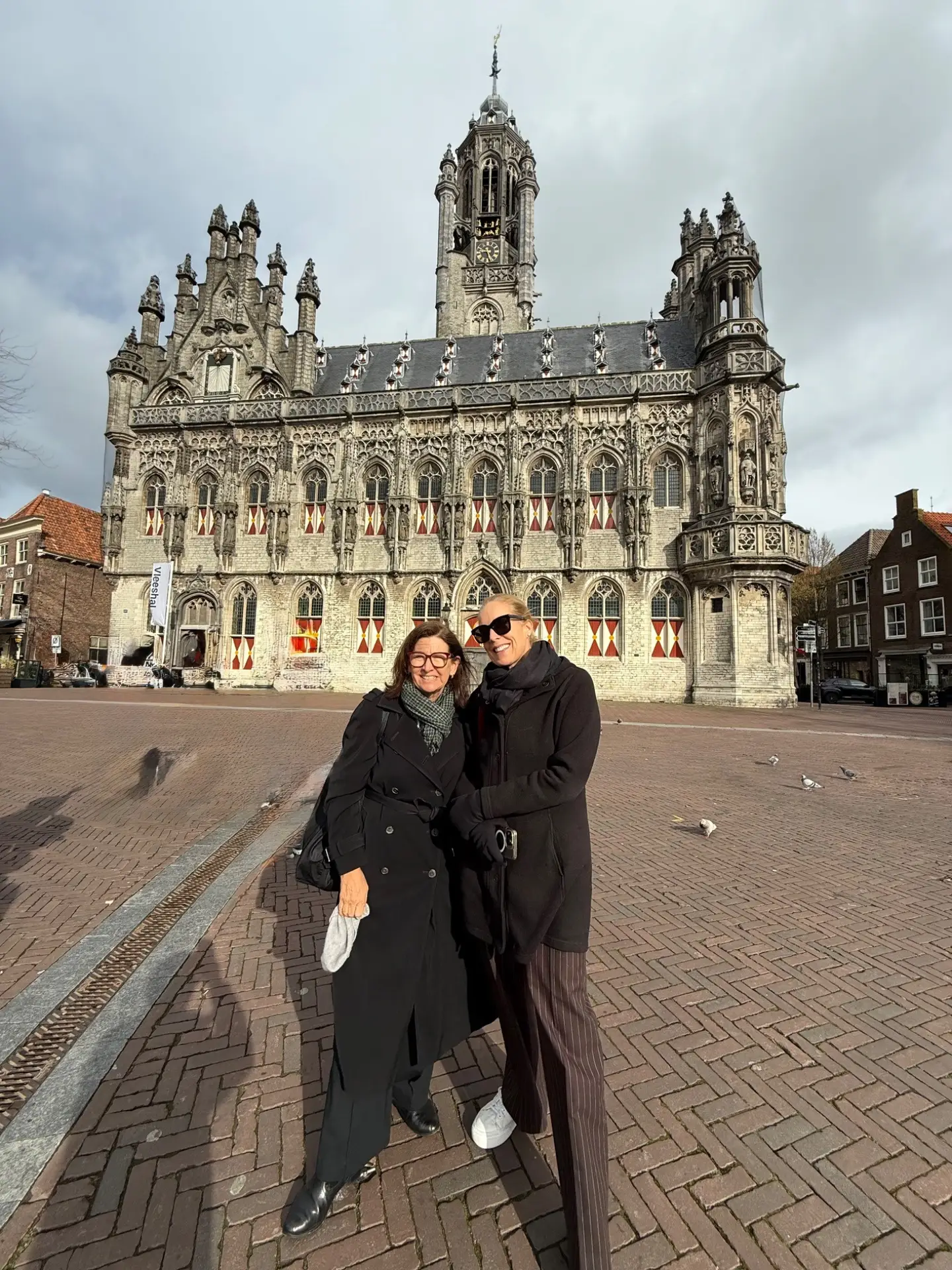
What do you think of when you think of the Netherlands? Canals, cheese, tulips, windmills, charming old cities, and villages. But here’s what more and more global families are discovering: universities in the Netherlands have become one of Europe’s most compelling destinations for international students, with a remarkable range of English-language university programs that deserve serious consideration.
I recently had the opportunity to represent RNG International on a Dutch University Consortium tour designed specifically for counselors who advise families on higher education options around the world. Having already visited several Dutch universities independently, I jumped at the chance to go deeper — connecting with admissions representatives, current students, and faculty across the country to bring back firsthand insight for the families we serve.
Over one very busy week, our group visited nine universities and colleges across multiple cities. What I came away with was a much clearer picture of what makes the Netherlands distinctive — and more importantly, what kinds of students genuinely thrive here.
What You Need to Know: The Dutch University System
Before diving into each stop, it helps to understand that universities in the Netherlands fall into three distinct categories: university colleges (small, liberal arts, and sciences-focused, highly selective), research universities (large, academically rigorous, globally ranked), and universities of applied sciences (career-oriented, hands-on, professionally focused).
Understanding the difference is essential to finding the right fit — and it’s exactly the kind of nuance that gets lost when families research on their own. For international students especially, arriving at this decision without guidance can mean overlooking institutions that would be a genuinely excellent match.
Hotel School of The Hague: Where Hospitality Meets Global Purpose
Our first stop was the Amsterdam campus of the Hotel School of The Hague, and it opened with something unexpected: an introductory class in chocolate. Seriously. But don’t let that fool you — the depth of the curriculum was impressive. The professor approached the topic from angles including sustainability, ethics, production economics, and global supply chains. It was a perfect illustration of how universities of applied sciences in the Netherlands blend professional training with genuine intellectual rigor.
Many graduates are working around the world for well-known international brands, which speaks to the strength of their global network — and to the real-world value of this kind of education for internationally mobile students.

Leiden University: 450 Years of Academic Excellence and Global Thinking
Next, we traveled to Leiden, where we boarded a boat to tour the historic canals that circle the city. Hot tea and stroopwafels kept us warm against the wind — a very Dutch welcome. Leiden University, founded in 1575 and the birthplace of Rembrandt, is one of Europe’s oldest and most respected research universities. But the real highlight was meeting the students. They were articulate, deeply engaged, and passionate about using their education to address global challenges. For international students drawn to academically rigorous environments with a genuinely cosmopolitan student body, Leiden is worth serious attention.
We also met students and representatives from Leiden University College, their small and highly selective liberal arts and sciences program offered in English and located in The Hague. For the right student — intellectually curious, globally minded, comfortable in a tight-knit academic community — it is a remarkable option that many families outside Europe simply don’t know exists.
Leiden itself is worth a visit for anyone exploring the Netherlands. The city is beautiful, walkable, and deeply connected to its university in a way that creates a rich student experience.

Utrecht University and University College Utrecht: Two Institutions, One City, Very Different Fits
Utrecht offered one of the most interesting contrasts of the tour. Utrecht University is a large, grand, well-respected research university with impressive architecture and a broad range of programs. University College Utrecht, by contrast, is intimate, discussion-driven, and deeply focused on the liberal arts and sciences, including full science programmes covering biology, chemistry, medicine, maths, physics, environmental science and more — taught entirely in English.
For international students weighing a large research university against a small liberal arts college, Utrecht is one of the best places in the Netherlands to see that contrast side by side. Visiting both in the same day was a useful exercise — I found myself thinking of specific students for each almost immediately. Fit matters enormously here, and these two institutions serve very different learners.

Erasmus University College and Erasmus University Rotterdam: Research, Community, and Life in a Bustling Port City
Rotterdam was a contrast to other places we visited, but nevertheless a real treat with its modern skyline and sophistication. We visited Erasmus University College first — a small, rigorous, and highly regarded liberal arts and sciences program — before heading to the main campus of Erasmus University Rotterdam, a large and energetic research university with a genuinely international student community.
Every student I spoke with was enthusiastic about their program, their friendships, and the experience of living in a dynamic port city. The cherry blossoms were in bloom around the lake at the center of campus, making for a genuinely beautiful scene that I wasn’t expecting.
Rotterdam is not the most charming, historic Dutch city — it was largely rebuilt after World War II — but it has an energy and a cosmopolitan spirit that many international students find deeply appealing. More than one student told me they chose Rotterdam specifically because it didn’t feel like a typical university town, and that turned out to be exactly what they needed.

Why Universities in the Netherlands Are Worth Considering for International Students
The Netherlands remains one of the most underrated destinations among international students exploring European higher education — and that’s exactly why we think it deserves a place on your family’s list.
Strong English-language programs, relatively affordable tuition compared to the UK or US, a safe and welcoming culture, and genuine academic diversity across institution types make it a compelling option. That’s true for a wide range of students, such as Third Culture Kids, expat students, those seeking something beyond the traditional American or British pathway, and high-achieving students who want a globally connected education without the price tag of some more well-known destinations.
Understanding which type of institution fits your student — and which specific programs align with their goals — is where the real work begins. It’s also where having a consultant who has actually walked these campuses makes an enormous difference.
Part Two
This is Part One of our series on universities in the Netherlands for international students. In Part Two, we continue the tour with visits to University College Roosevelt in the medieval city of Middelburg, HZ University of Applied Sciences, Tilburg University, Eindhoven University of Technology, and University College Maastricht — and we close with something no brochure will tell you: an honest look at which students genuinely thrive in the Dutch university system, and which students should think carefully before committing.
If you’re exploring English-language universities in the Netherlands for your student, Part Two is where the picture really comes together.
Written by Rebecca Grappo, founder and International University Counselor at RNG International Educational Consultants. Rebecca has visited universities across the United States, Europe, and beyond, bringing firsthand knowledge — not assumptions — to every family she serves.